
Archives by: Gary Hoag

Home » Gary Hoag

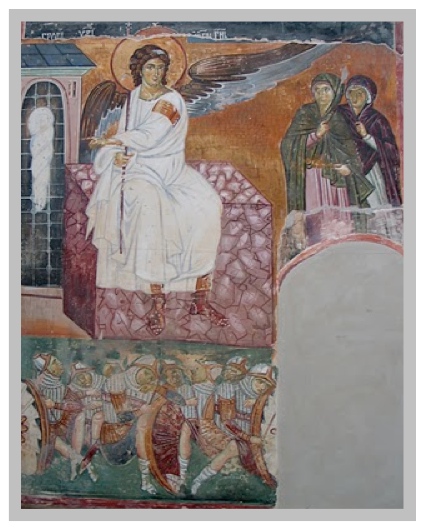
Fresco from Mileseva Monastery: The Resurrection

The fresco, painted in the first half of the 13th century on the south wall of the church at Mileseva Monastery in Yugoslavia, was intended to capture the scene on Easter morning as recorded in Matthew’s Gospel below. What do see when you contemplate this scene?

What do I find remarkable? Those not looking for Jesus, the soldiers, do not see or hear about the greatest news ever shared? Those who come looking, find more than they can ever imagine! They find an angel proclaiming: “He is not here, He has risen, just as he said.” May the empty tomb remind you today you can trust Jesus. He did what he said he would do! And may He richly bestow on you the gift He gives those who have not seen and yet still believe…faith!
fr1

After the Sabbath, at dawn on the first day of the week, Mary Magdalene and the other Mary went to look at the tomb. There was a violent earthquake, for an angel of the Lord came down from heaven and, going to the tomb, rolled back the stone and sat on it. His appearance was like lightning, and his clothes were white as snow. The guards were so afraid of him that they shook and became like dead men. The angel said to the women, “Do not be afraid, for I know that you are looking for Jesus, who was crucified. He is not here; he has risen, just as he said. Come and see the place where he lay. Then go quickly and tell his disciples: ‘He has risen from the dead and is going ahead of you into Galilee. There you will see him.’ Now I have told you.” Matthew 28:1-7

Artists: Three Painters of the Raska-School: Dimitrije, Djordje and Teodor.

Read more
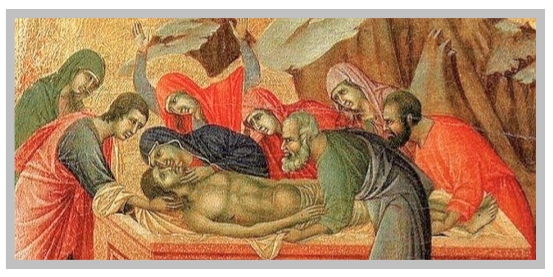
Pietà Duccio: Joseph, Nicodemus and others help prepare the body of Jesus for burial

The ancient pietà illustrates the generosity of Joseph of Arimathea, Nicodemus, and others in preparing the body of Jesus for burial. What do you see? I see worship. I see loving care. I see eyes with gaze locked on their Lord. I see their faith in action in providing a royal burial for Jesus.

fr2

Later, Joseph of Arimathea asked Pilate for the body of Jesus. Now Joseph was a disciple of Jesus, but secretly because he feared the Jewish leaders. With Pilate’s permission, he came and took the body away. He was accompanied by Nicodemus, the man who earlier had visited Jesus at night. Nicodemus brought a mixture of myrrh and aloes, about seventy-five pounds. Taking Jesus’ body, the two of them wrapped it, with the spices, in strips of linen. This was in accordance with Jewish burial customs. At the place where Jesus was crucified, there was a garden, and in the garden a new tomb, in which no one had ever been laid. Because it was the Jewish day of Preparation and since the tomb was nearby, they laid Jesus there. John 19:38-42

Pietà Duccio (date unknown).

Read more

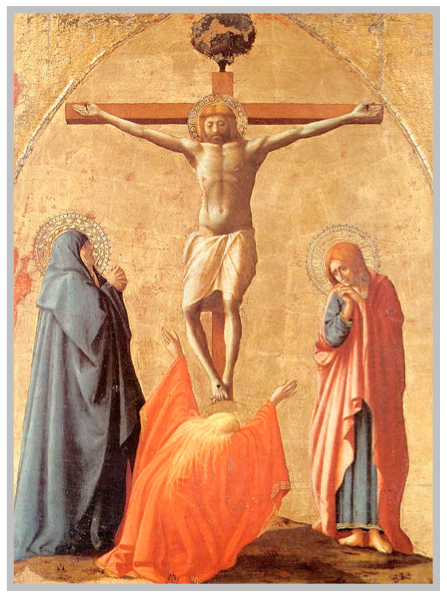
Masaccio: The greatest act of generosity of all time

Jesus performed the greatest act of generosity of all time, motivated by love, some 2,000 years ago today: He died on the cross for our sins, and not ours alone, but the sins of the whole world. Study this Masaccio entitled, “Crucifixion.” What’s your response to the crucifixion?

Fr3

When the centurion and those with him who were guarding Jesus saw the earthquake and all that had happened, they were terrified, and exclaimed, “Surely he was the Son of God!” Many women were there, watching from a distance. They had followed Jesus from Galilee to care for his needs. Among them were Mary Magdalene, Mary the mother of James and Joseph, and the mother of Zebedee’s sons. Matthew 27:54-56

Artist: Masaccio (1401-1428)

Read more

Jacopo Tintoretto: Christ washing the feet of His disciples

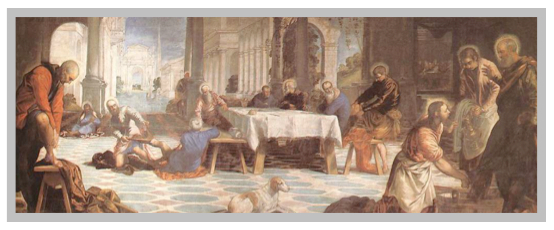
Christ modeled humility for His disciples some 2,000 years ago today. Study this Tintoretto entitled, “Christ Washing the Feet of His Disciples.” His teachable moment starts with a question, “Do you understand what I have done for you?” and ends with a blessing, “Now that you know these things, you will be blessed if you do them.” Once you understand, go and do likewise!

fres

When he had finished washing their feet, he put on his clothes and returned to his place. “Do you understand what I have done for you?” he asked them. “You call me ‘Teacher’ and ‘Lord,’ and rightly so, for that is what I am. Now that I, your Lord and Teacher, have washed your feet, you also should wash one another’s feet. I have set you an example that you should do as I have done for you. Very truly I tell you, no servant is greater than his master, nor is a messenger greater than the one who sent him. Now that you know these things, you will be blessed if you do them. John 13:12-17

Artist: Jacopo Tintoretto (1518-1594)

Read more

Valentin De Boulogne: Christ driving the money changers out of the temple

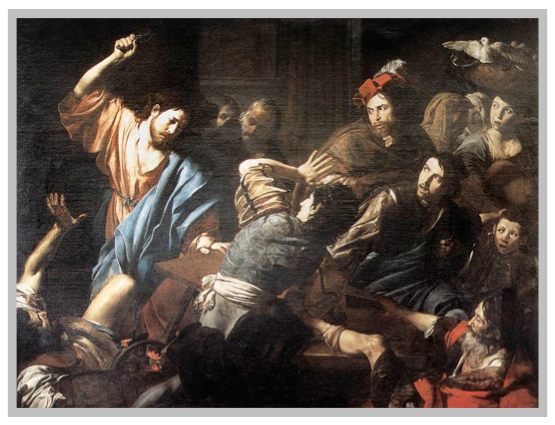
The greed of the money changers had led them to set up shop in God’s house and Jesus drove them out 2,000 years ago this week. In this De Boulogne entitled, “Christ Driving the Money Changers out of the Temple,” what do you see? I see Jesus cleaning out His Father’s House. I realize He will clean me out (or anyone else) who uses it as a place of making money!

fresksk

On reaching Jerusalem, Jesus entered the temple courts and began driving out those who were buying and selling there. He overturned the tables of the money changers and the benches of those selling doves, and would not allow anyone to carry merchandise through the temple courts. And as he taught them, he said, “Is it not written: ‘My house will be called a house of prayer for all nations’? But you have made it ‘a den of robbers.’” Mark 11:15-17

Artist: Valentin De Boulogne (1591-1632)

Read more

Rembrandt: 30 pieces of silver

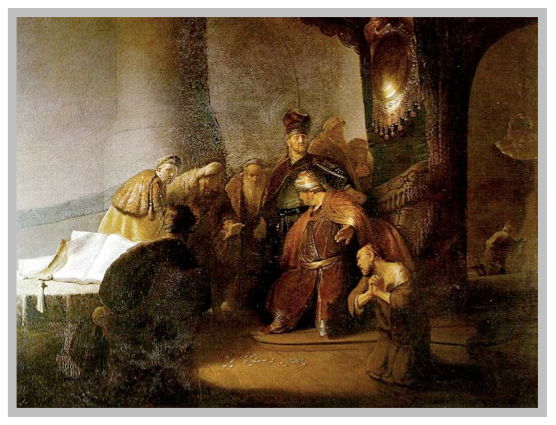
The greed of Judas led him to betray Jesus for 30 pieces of silver some 2,000 years ago today. In this Rembrandt entitled, “Judas Repentent, Returning the Pieces of Silver,” gaze into the image and take time to reflect on your own life: Has greed led you to sin for which you need to repent? Are you like the corrupt religious leaders who will use money to control situations?

rememe

Then one of the Twelve—the one called Judas Iscariot—went to the chief priests and asked, “What are you willing to give me if I deliver him over to you?” So they counted out for him thirty pieces of silver. From then on Judas watched for an opportunity to hand him over. Matthew 26:14-16

Early in the morning, all the chief priests and the elders of the people made their plans how to have Jesus executed. So they bound him, led him away and handed him over to Pilate the governor. When Judas, who had betrayed him, saw that Jesus was condemned, he was seized with remorse and returned the thirty pieces of silver to the chief priests and the elders. “I have sinned,” he said, “for I have betrayed innocent blood.” “What is that to us?” they replied. “That’s your responsibility.” So Judas threw the money into the temple and left. Then he went away and hanged himself. Matthew 27:1-5

Painting: Rembrandt Harmenszoon van Rijn (1606-1669).

Read more

Our Lady of the Lake Church: The anointing at Bethany

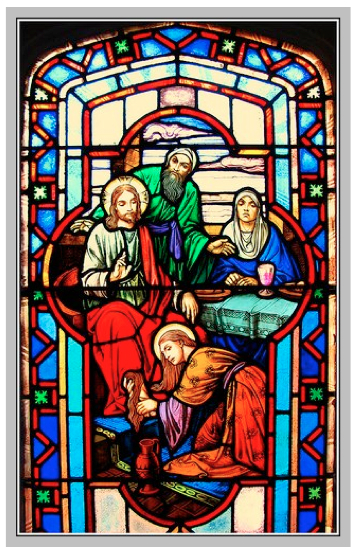
Reflect on this rendering of “The Anointing at Bethany” which happened some 2,000 years ago today. Where do you see yourself in the stained glass and the Scripture?

ourrrr

Six days before the Passover, Jesus came to Bethany, where Lazarus lived, whom Jesus had raised from the dead. Here a dinner was given in Jesus’ honor. Martha served, while Lazarus was among those reclining at the table with him. Then Mary took about a pint of pure nard, an expensive perfume; she poured it on Jesus’ feet and wiped his feet with her hair. And the house was filled with the fragrance of the perfume. John 12:1-3

When she poured this perfume on my body, she did it to prepare me for burial. Truly I tell you, wherever this gospel is preached throughout the world, what she has done will also be told, in memory of her.” Matthew 26:12-13

Stained glass: Our Lady of the Lake Church, Sparta, NJ.

Read more

Andrew of Crete: Let us run to imitate the passion of our Lord!

“Let us run to accompany him as he hastens toward his passion, and imitate those who met him then, not by covering his path with garments, olive branches or palms, but by doing all we can to prostrate ourselves before him by being humble and by trying to live as he would wish.”

Andrew of Crete (c. 650-740) in He Comes in Humility 2.1.

Read more

Gregory of Nazianzen: Serve Christ in the poor

“Let us visit Christ whenever we may; let us care for him, feed him, clothe him, welcome him, honor him, not only at a meal, as some have done, or by anointing him, as Mary did, or only by lending him a tomb, like Joseph of Arimathaea, or by arranging for his burial, like Nicodemus, or by giving him gold, frankincense and myrrh, like the Magi before all these others.

The Lord of all asks for mercy, not sacrifice, and mercy is greater than myriads of fattened lambs. Let us then show him mercy in the persons of the poor and those who today are lying on the ground, so that when we come to leave this world they may receive us into everlasting dwelling places, in Christ our Lord himself, to whom be glory for ever and ever. Amen.”
 
Another Lenten Reading from St. Gregory of Nazianzen (c. 329-389) in Serve Christ in the Poor, 5.

Read more

Gregory of Nazianzen: Let us not delay in being generous

“Blessed are the merciful, because they shall obtain mercy, says the Scripture. Mercy is not the least of the beatitudes. Again: Blessed is he who is considerate to the needy and the poor.

Once more: Generous is the man who is merciful and lends. In another place: All day the just man is merciful and lends. Let us lay hold of this blessing, let us earn the name of being considerate, let us be generous.

Not even night should interrupt you in your duty of mercy. Do not say: Come back and I will give you something tomorrow. There should be no delay between your intention and your good deed. Generosity is the one thing that cannot admit of delay.”
 
Another Lenten Reading from St. Gregory of Nazianzen (c. 329-389) in Serve Christ in the Poor, 1-2.

Read more
« Previous PageNext Page »