

Archives by: Gary Hoag

Home » Gary Hoag

Hippolytus of Rome: The generosity of God is reflected through His Son, Jesus

“This is my beloved Son,” yes. none other than the One who himself becomes hungry, yet feeds countless numbers. He is my son who himself grows weary, yet gives rest to the weary. He has no place to lay his head, yet bears up all things in his hand. He suffers, yet heals sufferings. He is beaten, yet heals confers liberty upon the world.”

Hippolytus of Rome (c. 170 – c. 236) Discourse on the Holy Theophany 7. TLG 2115.026, 7.5-6, 9-10, 12-20.

Read more
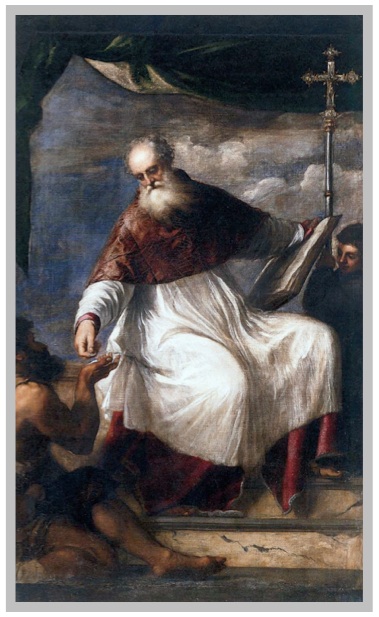
John the Merciful: Serve the poor as God hears their cries in His high court

St. John the Merciful, also known as St. John the Almsgiver, became widely known for his munificent liberality towards the poor. He made a list of several thousand needy persons whom he took under his especial care. He always referred to the poor as “his lords and masters,” because of their “mighty influence at the Court of the Most High.” God hears their cries for help!

St. John the Merciful (550-616) Catholic Encyclopedia (1913).

sjm

St. John the Merciful, by Titian, Church of San Giovanni Elemosinario in Venice.

Read more

Callistus of Rome: What giving is needed most from God’s people? Generously give mercy!

“My brothers, shun not only the holding, but even the hearing, of the judgment that bans mercy. For mercy is better than all whole burnt offerings and sacrifices.”

Callistus of Rome (c. 220) in The Second Epistle to All the Bishops of Gaul 6. ANF 8:618.

Read more

Severian of Gabala on the Holy Spirit’s role in our stewardship journey

“The Spirit in us tends toward fellowship with God. He gives ever more grace and turns us away from the love of the world.”

Severian of Gabala (c. 400) Catena. CEC 29.

Read more

Aphrahat: What to think about on the journey of life

“Let us think upon the things that are above, on the heavenly things, and meditate on them, where Christ has been lifted up and exalted. But let us forsake the world which is not ours, that we may arrive at the place to which we have been invited.”

Aphrahat (c. 270-350) in Select Demonstrations 6.1. NPNF 2 13:363.

Read more

Caesarius of Arles: What do you do with your riches?

“Riches cannot harm a good person, because he spends them kindly. Likewise, they cannot help an evil person as long as he keeps them avariciously or wastes them in dissipation.”

Caesarius of Arles (470-543) in Sermons 35.4. FC 31:175.

Read more

Bratcher and Reyburn: The theme of Psalm 49

“Riches are not permanent, and so people should rather put their faith in God.”

For all can see that wise men die; the foolish and the senseless alike perish and leave their wealth to others. Their tombs will remain their houses forever, their dwellings for endless generations, though they had named lands after themselves. Psalm 49:10-11

R.G. Bratcher and W. D. Reyburn in A Translator’s Handbook on the Book of Psalms (New York: UBS, 1991) notes on Psalm 49.

Read more

Arator: Store up treasures where they can suffer no loss.

“Generous one, you do not do these things as a seller of property, but, ambitious one, as out who wishes to keep his privileges, and you abandon for a short time what you desire to be yours forever. Thus, to scatter the fields was [really] the desire not to be in need; for of what advantage is property that perishes even though it is guarded? Whoever loses it has it to greater advantage laid up in the citadel of heaven. Seek there, creditor, the wealth of greater interest and lay up treasures where they can suffer no loss; there no misfortune wears away perpetual wealth; you will possess everlastingly what you cause the Lord to owe.”

Arator (490-550) Christian poet from Liguira, Italy. On the Acts of the Apostles I. De Actibus Apostolorum 36-37.

Read more

Basil of Caesarea: Christians share and serve

“The Christian ought to regard all the things that are given him for his use, not as his to hold as his own or to lay up. Moreover, giving careful heed to all things as the Lord’s, he should not overlook any of the things that are being thrown aside and disregarded, should this be the case. No Christian should think of himself as his own master, but each should rather so think and act as though given by God to be slave to his fellow brothers and sisters.”

Basil of Caesarea (330-379) Letter 22.1. NPNF 28:128.

Read more

Didymus the Blind: Freely help the helpless because it is better to give than to receive!

In everything I [Paul] did, I showed you that by this kind of hard work we must help the weak, remembering the words the Lord Jesus himself said: “It is more blessed to give than to receive.” Acts 20:35

“These words are spoken to the leaders of the church so that, in addition to other things, they might judge themselves imitators of Paul by refusing to accept money. This is quite obvious from the words that follow: “I have given you an example in all things that those who toil must come to the help of the weak” and provide for them. If the words should be remembered, they will provide the principle: “It is better to give than to receive.”

Didymus the Blind (313-398) in Catena on the Acts of the Apostles 20.34. CGPNT 3:341-42.

Read more
« Previous PageNext Page »